
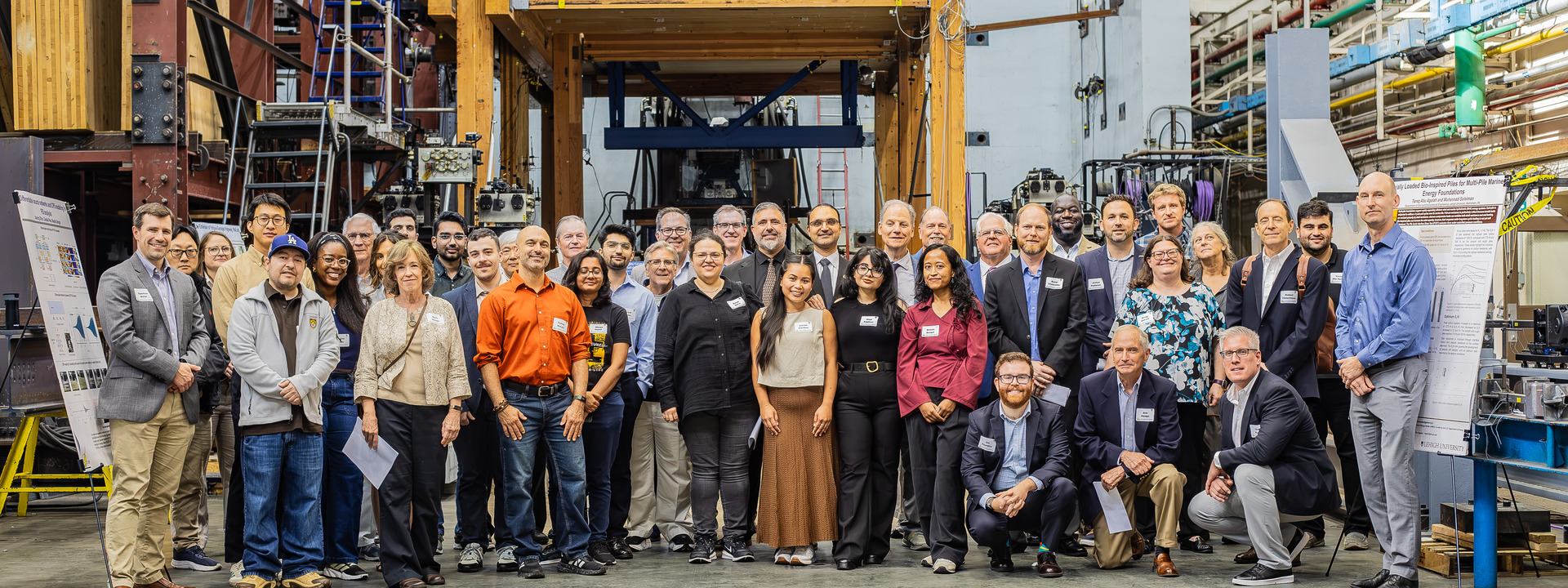
After 40 years of success, you might think that the Advanced Technology for Large Structural Systems (ATLSS) Engineering Research Center at Lehigh University would be satisfied with its reputation as a top U.S. structural testing laboratory. Not so: At the recent celebration of the center’s milestone anniversary, half of the event’s time was devoted to strategizing how the center can build support for future impact. The October 1-2, 2026, gathering, which resembled both a corporate brainstorming session and a homecoming party, attracted current Lehigh researchers, staff, and administrators as well as many alumni who are still active in the engineering industry, plus current students and postdoctoral researchers.
Recurring themes at the event included the legacies of past leaders (such as John Fisher, ATLSS founder and Professor of Civil Engineering; Dan Frangopol, Fazlur R. Khan Endowed Chair of Structural Engineering and Architecture; and Richard Sause, Joseph T. Stuart Professor of Structural Engineering), collaborations, and a recurring need for innovation and reinvention. Multiple speakers invoked the vision of John Fisher; Lynn Beedle, Professor of Structural Engineering; and others, as well as the multiple partnerships developed with industry and government agencies not only to perform testing and research but also to keep ATLSS funded.
The event kicked off in the early afternoon of October 1, with ATLSS Director and Bruce G. Johnston Professor of Structural Engineering James M. Ricles delivering the welcoming address, including an overview of the event’s agenda. He was followed by a welcome from Lew and Sherry Hay Dean of the P.C. Rossin College of Engineering and Applied Science Steve DeWeerth and by Bill Michalerya, who arrived at Lehigh in 1988, or as he described it, “the beginning of the year where we had our three-year live or die renewal” from the National Science Foundation (NSF), ATLSS’s supporting agency.
Michelayra, whose first title at Lehigh was Industry Liaison, was intimately involved in the initial continued existence of ATLSS. He described his ever-evolving role in promoting–and funding–ATLSS, and shared some vintage photos from the center’s early days, dug out of a filing cabinet at ATLSS’s present day office. Michelarya’s description of the early days epitomized a “seat of the pants” strategy, as he, Fisher, and Lehigh administrators formed partnerships and initiatives with industry and the Commonwealth of Pennsylvania to fund ATLSS, which had an initial mandate from the NSF to become self-sustaining in three years. The real keys to success, Michelarya said, were the leadership, comprised of John Fisher and Al Pense, Professor of Materials Science and Engineering https://news.lehigh.edu/remembering-alan-w-pense-former-lehigh-provost-and-vice-president-of-academic-affairs, who were able to “open their Rolodex” and find a wide range of partnerships to satisfy NSF teaming requirements, as well as “unique experimental facilities” and “strong industry partnerships.” He said, “this idea of ERCs [engineering research centers] was a new model for NSF, a new funding mechanism, but not a new model for Lehigh.” Among the early challenges posed by the NSF for the ATLSS founders were the creation of broader–i.e., non-steel–industry partnerships, as well as requirement for center-wide strategic vision, not just a collection of individual faculty researchers.
The results were continued funding, successful partnerships, and a first crop of ATLSS graduate students eager to work with Fisher, Beedle, Pense, and other faculty at Fritz Lab on lower campus, and at the newly acquired Homer Research Laboratories Complex from Bethlehem Steel, then renamed Mountaintop (price tag: $20 million, or $60 million in today’s dollars). This wave of researchers was represented at the 40th Celebration by University of Arizona Professor of Civil Engineering and Engineering Mechanics Robert Fleischman (MS, PhD Civil Engineering 1989, 1995) who succeeded Michelarya at the podium. Fleischman invoked an era of shared discovery among a cohort of graduate students, guided by faculty at the top of their profession. This was exemplified in an anecdote Fleischman told about his decision to pursue a PhD: “One evening I was working on my specimen and John Fisher stopped down, and he asked me to stay for a PhD. The honor that someone of his stature wanted me–I made the decision during that meeting that I was staying for a PhD.”
Fleischman also talked about the transition of some of his research to Network for Earthquake Engineering Simulation (NEES), saying that the proposal was initially a NSF Grant Opportunities for Academic Liaison with Industry (GOALI) that NSF turned into a pre-NEES effort, which eventually led to NEES and ultimately to NHERI. Fleischman now conducts his own research at ATLSS, creating ties with his University of Arizona students and ATLSS, as well as with his former classmates who have continued in engineering. “For someone like me at a school without a lab to be able to use the shared use of places like Lehigh and UC San Diego, it's a real dream come true,” he said.
Although Lehigh University hosts ATLSS and has a significant role in supporting the center, NSF plays a significant role as well. Its continued support makes testing at the center possible, and a Zoom appearance by Giovanna Biscontin, NSF Program Director, underscored the level of importance NSF attributes to ATLSS. Biscontin has succeeded Joy Pauschke as NHERI program manager (formerly NEES steward). Biscontin stated that she’s “seen how much the ATLSS Center has contributed and is providing world-class, cutting-edge, novel facilities and equipment. It's developing new ways of testing, new testing approaches, and is continuing to provide research and research support at the forefront of our field.”
After Bisconti’s address, attendees were shuttled to the Imbt building for a tour of testing facilities and an overview of each provided by a faculty member: ATLSS lab, with its rigid reaction wall (Joseph Saunders, Operations Manager, NHERI RTMD Experimental Facility); the NHERI Control Room, the center for real-time hybrid and multi-directional structural experiments (Faisal Nissar Malik, doctoral student), structural fire testing furnace, with large-scale capacity (Spencer Quiel, Associate Professor of Structural Engineering and Co-Associate Director of I-CPIE), real-time cyber-physical multi-directional shake table testbed, with multi-directional earthquake loading ability (James M. Ricles), soil-foundation-structure interaction laboratory with multiple loading capacities (Muhannad Sulieman, Professor of Geotechnical Engineering and Deputy Director of ATLSS), and the ERC experimental gasification facility, with a laser-based monitoring system (Carlos Romero, ERC Director and Research Full Professor).
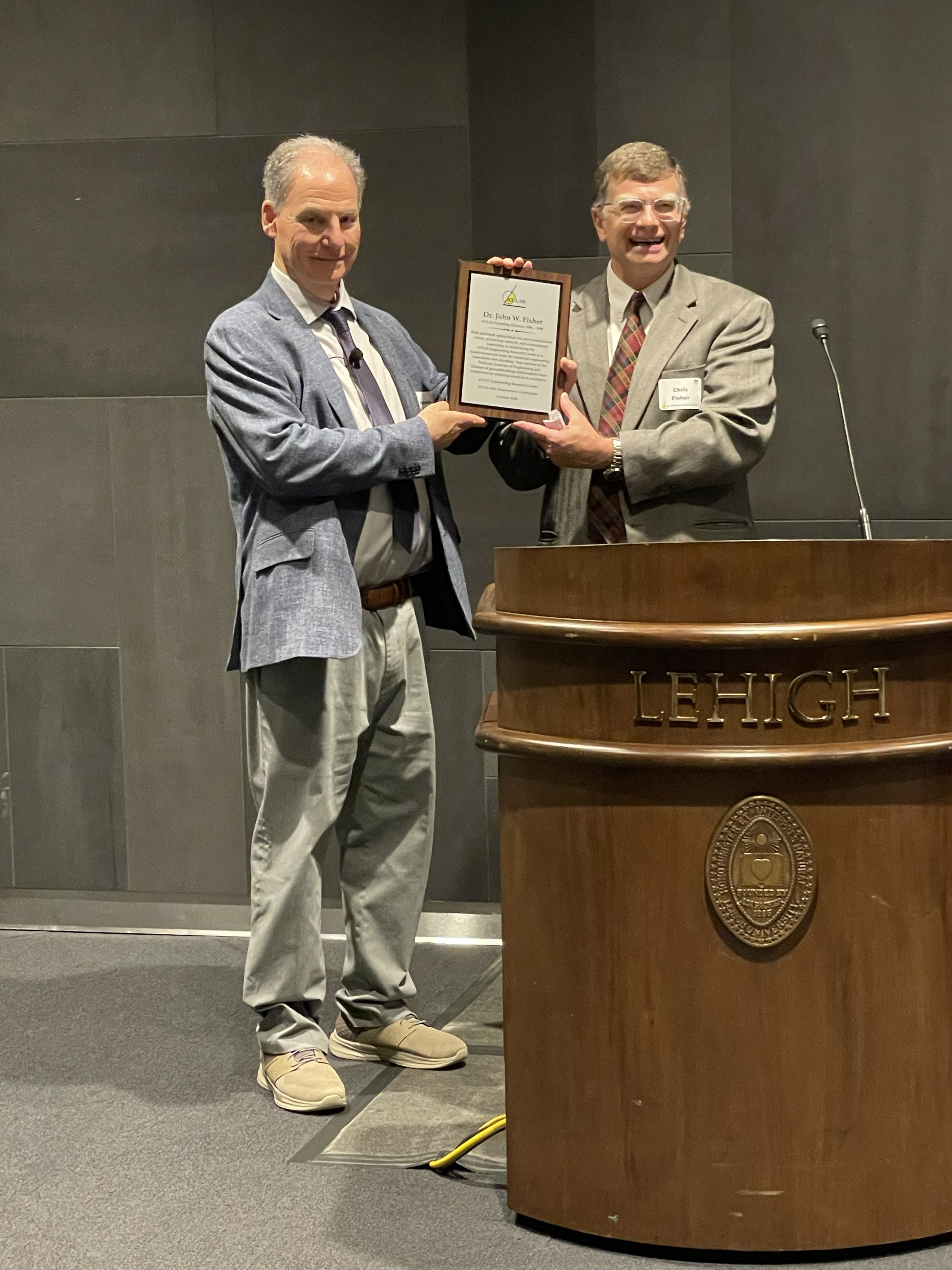
Before the night-capping dinner, attendees took time to honor past ATLSS leadership, including founder John Fisher, now 95, who for health reasons could not attend. Fisher’s son Chris accepted his father’s plaque from Jim Ricles, and said that his father felt honored to receive recognition. Emeritus faculty Dan Frangopol and Richard Sause appeared via Zoom, recapping their tenures as the inaugural holder of the Fazlur R. Khan Endowed Chair of Structural Engineering and Architecture and Joseph T. Stuart Professor of Structural Engineering and ATLSS Director, respectively, and reflected on their careers at ATLSS.
The Friday morning time slot began with Shamim Pakzad, Professor and Chair of Civil and Environmental Engineering, providing an overview from the Department of Civil and Environmental Engineering perspective. Pakzad reflected on the significance of ATLSS, saying, “For me, ATLSS is much more than a research center. It is in many ways the embodiment of structural engineering research at Lehigh and within the CEE department.” Pakzad then pivoted to the present-day strengths of the department. Many faculty are involved in interdisciplinary work, generating research at the intersections of infrastructure-critical disciplines. He also discussed the growth of CEE for both undergraduate and graduate students, and the faculty’s engagement with artificial intelligence (AI), saying the goal is not for students to just be AI literate, but AI fluent.
From Pakzad’s civil engineering perspective, the focus on the future of ATLSS transitioned to an industry perspective, featuring Lehigh alum: Bill Bruin, Executive Principal, Structural Engineering, West, SGH (MS, Civil Engineering 1995); Brent Chancellor, Associate Principal, WJE (PhD, Structural Engineering, 2014); Karl Frank, Professor Emeritus, Warren S. Bellows Centennial Professor in Civil Engineering, University of Texas at Austin (MS, PhD Civil Engineering 1969, 1971); and Ben Graybeal, team leader for Bridge Engineering Research with the Federal Highway Administration (FHWA) (MS, Structural Engineering, 1998), and moderated by Spencer Quiel, Co-Associate Director of I-CPIE and Associate Professor of Structural Engineering. Each noted how their time at Lehigh has yielded dividends throughout their careers (Bruin said “outstanding technical education,” while Ben said, “ATLSS initiated my career in research.”) These alumni discussed the needs they see in their own company and sector, and contributed ideas for how ATLSS might be able to help, developing shared standards for construction to improved communication to tighter industry partnerships.
Jim Ricles took the podium to discuss ATLSS “shaping the future,” discussing how the facility can draw on its past and current strengths to “extend our capabilities and our identity.” His strategic focus, he said, is on advanced and intelligent large-scale experimentation, shared-use and remote experimentation, and AI-enabled digital and cyber-physical systems, especially in multiphysics–as well as the funding and workforce needed to continue this work.
The event’s final panel consisted of current faculty who presented their research work. Panelists included Quiel, who works on infrastructure resistance to extreme loads including fire; Muhannad Suleiman, Deputy Director of ATLSS and Professor of Civil and Environmental Engineering, who works on soil interactions with offshore wind applications; Paulo Bocchini, Professor and Director of the Center for Catastrophe Modeling and Resilience, who works in computational modeling and probabilistic modeling for systems; Claudia Reis, Assistant Professor of Civil and Environmental Engineering, who researches resilient coast infrastructure and natural hazards; and Diego Heredia Rosa, Assistant Professor of Civil and Environmental Engineering, who focuses on extreme loads at multiple scales. The question-and-anwer session focused on ways ATLSS can work with industry, and the various ways the center can add value to industry projects. One focus was workforce development, with students an obvious resource for research and data collection. However, this trainee workforce can incur a cost, and the academic calendar and environment can cause delays that aren’t friendly to industry partners. Many expressed a desire for closer partnerships between ATLSS and industry, and various methods to construct this were expressed.
The last 40 years have witnessed countless technology innovations: email, GPS, LED, Powerpoint, ATMS, and the personal computer. ATLSS has thrived among such innovations, building its testing and computing power alongside other academic institutions and technology companies. Along the way, it has set standards for bridge engineering, pioneered real-time hybrid testing, engaged with well over one thousand partners, published more than 250 journal publications, and educated countless undergraduate and graduate students, many of whom have gone into industry or academic themselves. How ATLSS plans to use its resources–equipment, manpower, dedicated alumni, and committed administration, and students who enter the industry and academic workforces–to build and grow, will be seen over the next 40 years.
____
Thank you to the ATLSS 40th Anniversary Celebration Planning Committee: Chad Kusko, Sandy Nemeth, James Ricles, Joseph Saunders, and Ruby Scott, as well as to photographer Mahawa Bangoura, who shot the testing facility images.