
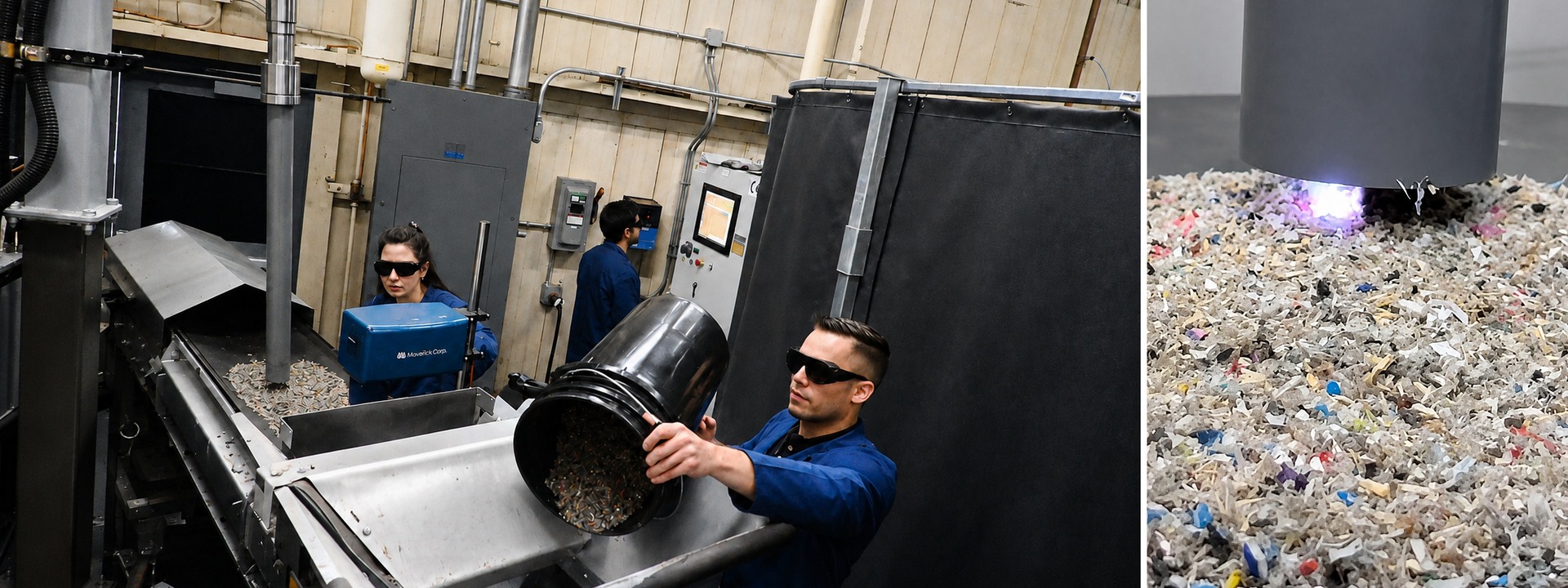
Municipal Solid Waste (MSW)–commonly known as residential trash and likely to end up in a landfill–can be processed via gasification into a H2/CO syngas and biofuel. The benefits of this process include reducing landfill footprints, mitigating the environmental impact of MSW, and increasing the supply of renewable fuels. Processed and refined MSW is a Refuse-Derived Fuel (RDF), a combustible fuel for use in combustors or gasifiers. Gasifiers offer environmental benefits over combustors by producing renewable liquid fuels or chemicals with minimal air emissions. One barrier to this process arises from the nature of the RDF, which is a heterogeneous material with highly variable characteristics; this irregularity impacts the optimal operation and yield of the gasifier.
Using laser-based technology developed by the Energy Research Company (ERCo) and Artificial Intelligence (AI) proprietary algorithms developed by Lehigh University, a team composed of Lehigh’s Energy Research Center (ERC), ERCo, SpG (a consulting firm in the WTE, or waste-to-energy, space), the University of Toledo and the Department of Energy’s (DOE’s) National Energy Technology Laboratory (NETL) worked on developing a Machine Learning (ML)-enhanced Laser Induced Breakdown Spectroscopy (LIBS) for real-time characterization of RDF as it is fed into gasifiers. This project originated from a grant funded by DOE’s Bioenergy Technology Office (BETO), which is now the Alternative Fuels and Feedstocks Office (AFFO) under the Office of Critical Minerals and Energy Innovation (CMEI), and received partial support from the Pennsylvania Infrastructure Technology Alliance (PITA) program. Carlos Romero, Director of Lehigh University’s Energy Research Center (ERC) and Professor of Mechanical Engineering and Mechanics, says that “there is a high motivation to develop analytical tools that would be used to better control and optimize the operation of gasifiers as well as boilers and incinerators in general.”
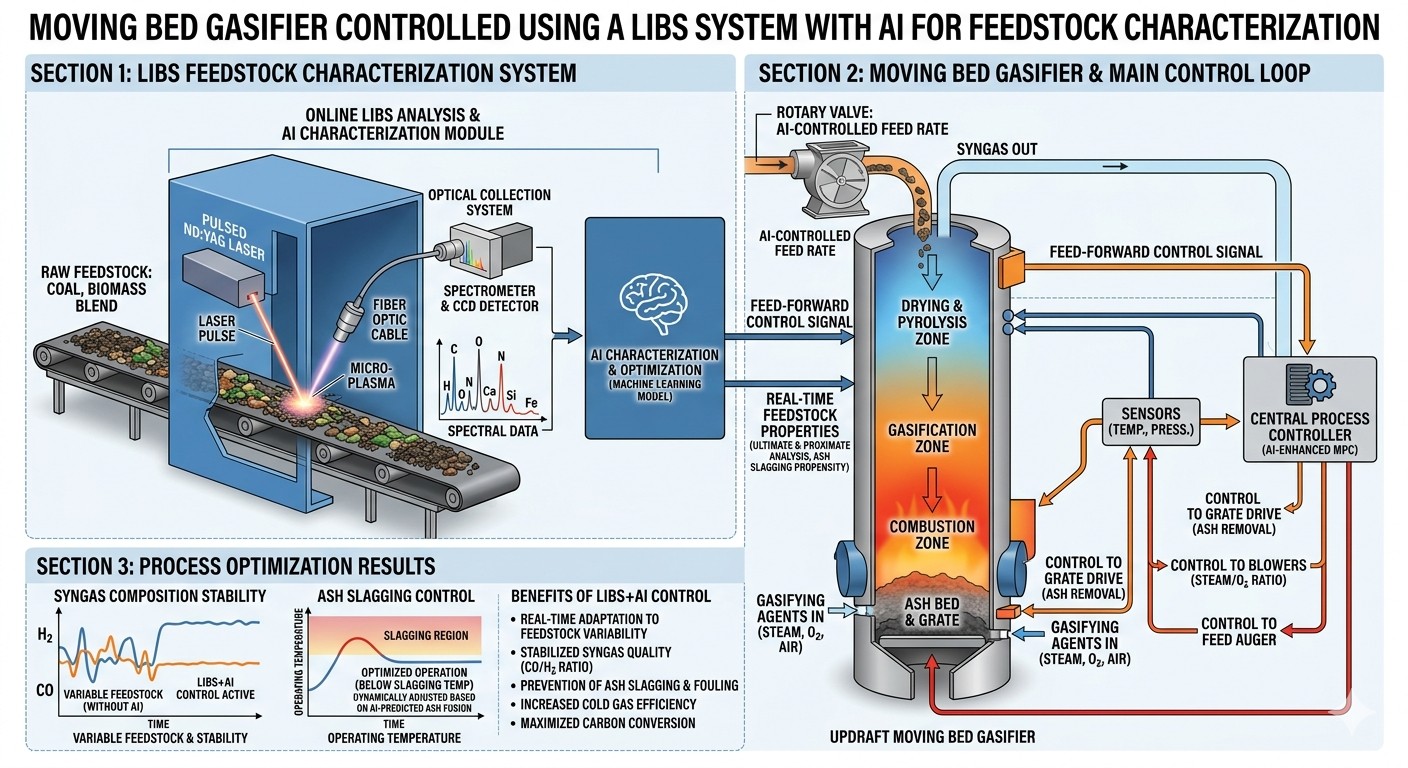
The LIBS process relies on laser pulses to analyze materials quickly. The laser’s light is focused on the material, and the intense energy generates a micro plasma (an electrically charged gas) that emits radiation when the electrons in the plasma relax to their ground states. The “spectroscope” part of the process measures this radiation, consisting of its wavelength and amplitude, identifying the element and its concentration. Artificial Intelligence then uses this raw spectra to determine high order parameters such as heating value, slagging potential, and elemental concentrations. The approach has been turned into an industrial-grade solution which includes ERCo’s OnSpec LIBS system and Lehigh’s AI software capable of providing 18 feedstock parameters in near-real time, which characterize the material as it flows on the feed system to the gasifier. These parameters include feedstock proximate and ultimate analysis, calorific value, ash mineral content and fusion temperatures, and trace impurities, such as chlorine.
The research team was able to determine the accuracy of the ML-enhanced LIBS solution relying on the American Society of Testing Materials (ASTM)’s standards for this type of real-time analyzers. Material samples were collected under standardized guidelines and sent to an outside lab for further comparison with synchronized results from the newly developed tool. Compared to the standards, the ML-enhanced LIBS system tested highly for accuracy and for precision, scoring 3.8 and 3.3% accuracy and precision for heating value, respectively.
The ML-enhanced LIBS system will be used in future projects. A deployment at the University of Utah, where there are two gasifiers, is already on the calendar. The testing at Lehigh and Utah also has a control aspect where a new paradigm for how this system can be incorporated into a feed-forward control aspect of those gasifiers will be tested.