
Four Lehigh University faculty researchers, including Shalinee Kishore, Director of Lehigh’s Center for Advancing Community Electrification (ACES), attended a Department of Energy (DOE) invite-only meeting on February 18, 2026, to participate in a new presidential administration initiative called Genesis Mission (GM). They joined researchers from other universities, philanthropic organizations, and national labs from around the nation in Arlington, Virginia, to explore the ways in which they could contribute to the challenges set out by President Donald Trump in an Executive Order (EO) on November 25, 2025, called “Launching the Genesis Mission.”
The EO laid out a vision for a science and technology research project fueled by and focused on artificial intelligence (AI) and designed to push the United States to the global forefront of AI, scientific discovery, and economic growth. The EO compares the Genesis Mission effort to the World War II Manhattan Project dedicated to developing an atomic weapon: like that effort, the Genesis Mission will require a large number of geographically distributed yet coordinated resources to meet its goals. Those goals are, as the EO says, to “double the productivity and impact of American science and engineering within a decade” using AI
The invited group from Lehigh included Kishore, who is also Iacocca Chair Professor of Electrical and Computer Engineering and a Director Emeritus of the Institute for Cyber Physical Infrastructure and Energy (I-CPIE); Tamás Terlaky, Director of Lehigh’s Quantum Computing and Optimization Laboratory and Alcoa Foundation Endowed Chair Professor in Industrial and Systems Engineering; Bilal Khan, Director, Health Data Warehouse and Professor of Biostatistics and Health Data Science and Computer Science and Engineering; and Eugenio Schuster, Director of the Plasma Control Laboratory and Professor of Mechanical Engineering and Mechanics.
The 17 national labs, located around the country, will be the primary drivers of the Lighthouse Challenges. Kishore hopes that she and ACES faculty can reach out to their contacts at national labs to make connections. In conjunction with this meeting, the DOE has released a request for information, or RFI, so Kishore and her Lehigh colleagues are developing a response. Genesis Mission plans to announce the first wave of teams early this summer.
“The bottom line,” Kishore says, “is that we need to strengthen our relationship with national labs and strategically decide which Lighthouse Challenges we can involve ourselves in.”
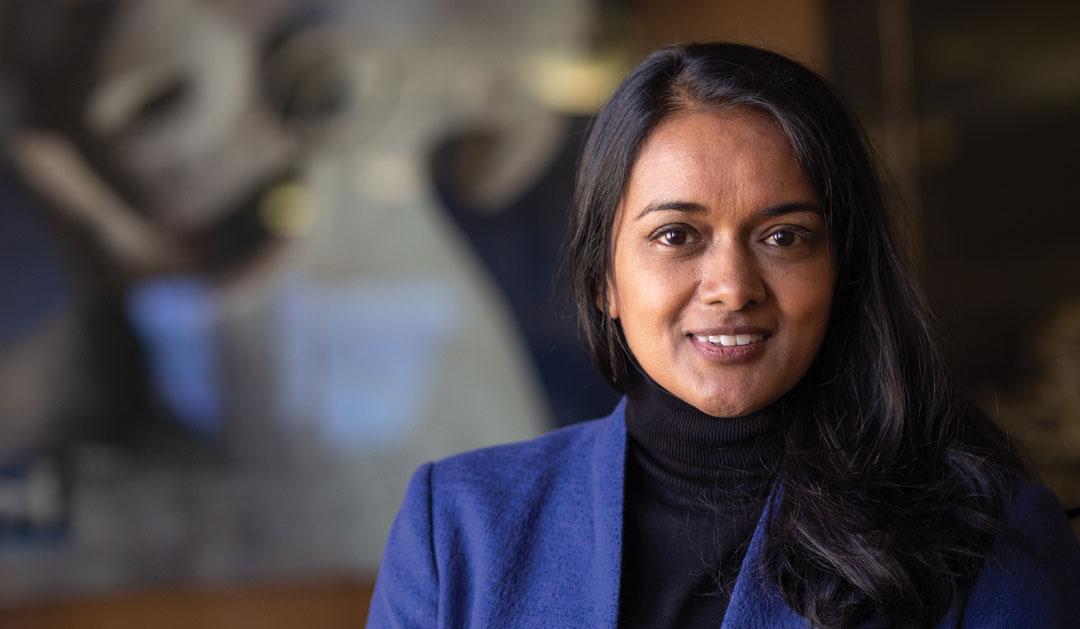
The Department of Energy (DOE) identified 26 research areas as Lighthouse Challenges, or areas of particular focus, for the GM. With the recent establishment of ACES and the industry and nongovernmental (NGO) networks established by its October 2025 Symposium on data centers, water, and energy, Lehigh University is well positioned to contribute to several of these Lighthouse areas, Kishore says. Kishore identifies three in particular (Lighthouse Challenge 11, Securing U.S. Leadership in Data Centers; 17, Predicting U.S. Water for Energy; and 18, Scaling the Grid to Power the American Economy), as well suited for ACES expertise. In addition, there are identified Lighthouse Challenges in Fusion, Critical Minerals, Advanced Manufacturing, Microelectronics, and Quantum Computing that would align with Lehigh expertise. The DOE also has onboarded 24 industry partners. Kishore sees the DOE building a “consortium model” for research, with a group of national labs, industry organizations, science philanthropies, and universities working together to solve problems.
During the event, Kishore and the other Lehigh faculty attended breakout sessions on topics such as the Lighthouse Challenges, Institutional Partnership Innovation, Data and Computing, and Workforce Development and Engagement, and discussed with other participants the possibilities and barriers they identified within Genesis Mission. She says these discussions centered around some fundamental issues, such as what resources the 26 challenges might need, how those resources might be allocated, and a possible clash on research culture and objectives between academics and industry.
Kishore left the meeting with many questions and a feeling that finding the best fit and partnerships for Lehigh’s specific research strengths may be a challenge. But to Kishore, it’s a challenge that can lead to growth and increased collaborations for ACES and Lehigh overall. She hopes that Lehigh can contribute to the Genesis Mission and be part of the fundamental shift to AI-driven science and technology.