
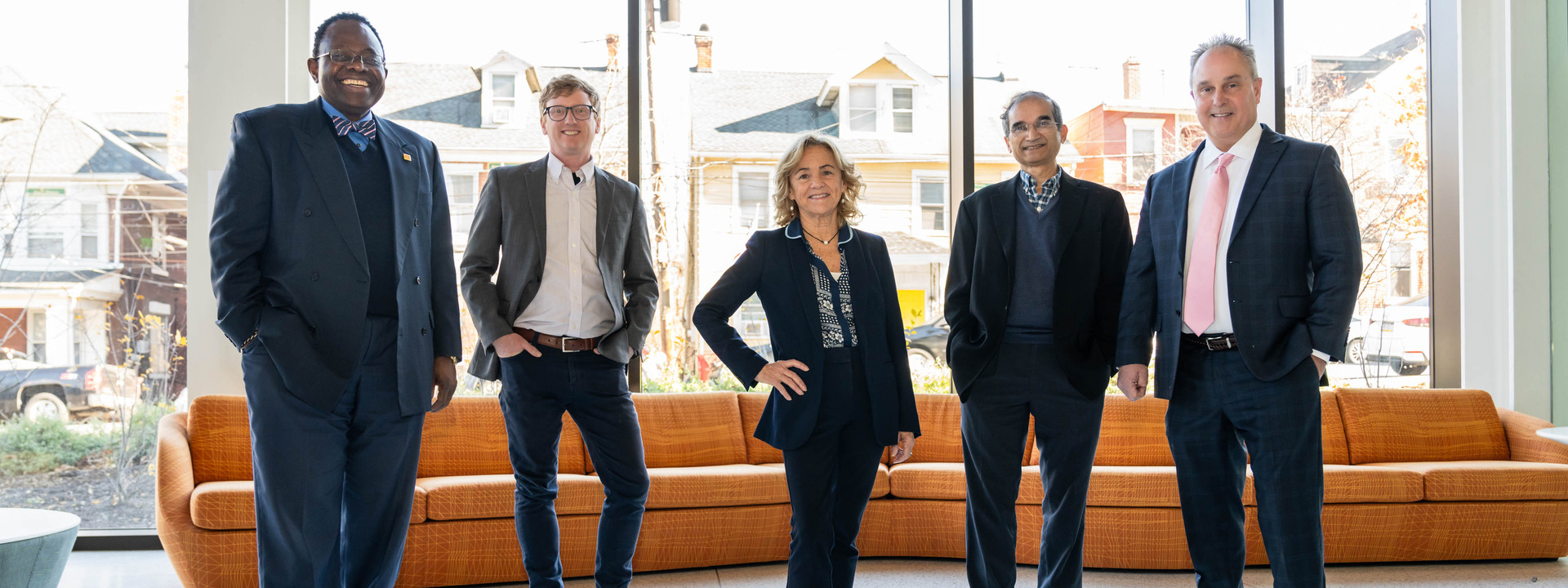
Often, research developed in a university lab falls into the Valley of Death on its way to being applied in the real world.
It can be a difficult valley to escape. The project itself was likely funded by a grant from a federal or state agency, or a foundation, for a fixed amount of time. And there may be an investor willing to fund the discovery after it has shown promise for successful commercialization. But when a discovery needs a little more work before it can pique industry or investor interest, this gap in funding, during which crucial proof of concept demonstration or prototype development occurs, can be a death knell.
That’s where Lehigh University’s Research Translation AcceLUrator (RTA) steps in. This program, now in its second year, helps academic researchers move their discoveries out of the lab and into the marketplace, a process few researchers learn while in graduate school or even during their postdoc or early career years.
The driving force behind the RTA is principal investigator (PI) John Coulter, Professor of Mechanical Engineering and Mechanics, and Associate Vice Provost for Research Translation at Lehigh University. Coulter says that “the valley of death” may sound dire, but it doesn’t have to be fatal. And the RTA’s mission is to help researchers learn how to build a bridge over that gaping valley.
RTA’s History
Lehigh’s RTA program started with a National Science Foundation (NSF) Accelerating Research Translation (ART) award announcement published in early 2023 and recognized by Lehigh administrators as a good fit for the university. To prepare Lehigh’s submission, Provost Nathan Urban asked Coulter to lead the proposal team. Coulter recalls that he intended “from day one” that “this would be Lehigh as an entire university, not a component of Lehigh,” so he recruited team members from each of the five Lehigh colleges to be part of the effort.
His vision for the proposal built on previous activities at Lehigh that, he says, “were focused on enhancing our level of societal impact from our research and connections to society,” such as an NSF Regional Innovation Engines proposal in 2022.
Coulter’s team of 16 included Anand Jagota, Vice Provost for Research, and came together fairly quickly, Coulter says. The proposal designed a series of programs designed to work together to bring research projects from the lab to the market (that’s the “translation” part), bridging the gap between initial research support and real-life application.
In the process of helping researchers—whether professors or graduate students—perform that translation, the RTA will, over time, gradually accomplish its larger goal: transforming the overall research culture at the university by broadening course offerings to develop an understanding of translation and commercialization as well as expanding tenure and promotion criteria to also include the activities that bring research discoveries to the public. Or as Coulter says, recognizing research translation “as a meritorious research activity in itself.”
The NSF required an institutional mentor for this huge undertaking, so Lehigh asked Carnegie Mellon University (CMU) to take on that role. CMU has made its mark in research translation–you might have heard of one of its more literal translational activities, Duolingo. CMU has also worked with entrepreneurs in agricultural robotics and a host of machine-learning and artificial intelligence companies. With existing relationships on other research projects and a common home state, the pairing felt like a good one to Coulter.
It felt right to the NSF, too. The agency announced that the proposal was approved in February 2024, and Coulter proudly reports that of the 18 awards disbursed in this cohort, “only five received the full $6 million—and we were one of those five.” While the program falls into NSF’s ongoing ART program, each of the award recipients has adopted a new name reflecting its specific focus. Lehigh generally uses the RTA acronym, reflecting its goal of research translation acceleration.
Three Pathways
The RTA identifies three pathways for research translation: new venture creation, translation to existing industry, and direct societal impact.
The first is the most obvious: create a venture, such as a new business. In Coulter’s words, “You have research from the university that leads to a small company, a startup, a spin-off. The innovations get out to the world through that new venture.” The RTA can help move that research toward formation of a new company. It can develop the product with additional capital, which might be from private sources, federal or state agencies that support small businesses, or a foundation where there is an alignment of interest.
The second pathway involves licensing the intellectual property to another, already existing, entity. No new venture is formed in this pathway—it’s more like a relay with Lehigh handing off the intellectual work to industry. “For example,” says Coulter, “I work with a large company, and then that large company licenses the technology from Lehigh. It may hire the postdocs or the PhD students that worked on it, and the transformation of the technology into the world is accelerated.”
The third pathway, Coulter says, “we call direct societal impact.” One example would be the creation of a software that helps a group—maybe children with some kind of developmental issue or high school students navigating college choice—in some way. That software can be released as open source so it’s available to everyone. The benefits are realized society-wide at no cost to the users. “There’s no new venture, no licensing,” Coulter says.
The RTA Ecosystem
Fundamentally, the RTA consists of an ecosystem of knowledge about translation that can help researchers advance their discoveries along these three pathways. The building blocks of this ecosystem are directed at educating researchers to become, if not entrepreneurs, then at least capable of advancing their product to an audience broader than researchers in the field. This ecosystem involves, in RTA parlance: 1) one-credit learning modules for graduate students, plus a summer research program for undergraduates and graduate students; 2) Seed Translational Research Projects (STRPs), which offer funding to operationalize translation projects; and 3) Pathway Champions, faculty and staff who are veterans of technology transfer acting as advisors to Lehigh researchers.
Learning modules are tuition-free courses designed for doctoral students. These courses are largely developed by Michael Lehman, Professor of Practice in the Department of Mechanical Engineering and Mechanics. Lehman, along with Andreea Kiss, Professor in Lehigh’s College of Business, in consultation with the RTA team, identifies content that is needed, and develops courses in those subject areas. Lehman and several adjuncts with connections to Lehigh and relevant expertise teach them. These courses have been well received: Some students reported, Major says, that “they were among the most impactful courses they've taken during their graduate time here.”
Designed to boost the students’ professional development in the research translation space, they are directed toward the practicalities and intricacies of making research impactful for social change. Spring 2026 courses, for example, include “Prototyping Across Disciplines: Ideate, Integrate, Iterate” and “Blueprint for Success: Frameworks for Assessing Market Potential of Research,” while previous semesters have included topics such as intellectual property strategies and communicating with industry stakeholders.
For undergraduate students, the RTA has a summer “bootcamp experience.” The first was held in 2025, with a cohort of 12 students, including 10 undergraduate and 2 graduate students, working in faculty labs for 10 weeks, during which they contributed to the project and to efforts to translate the research into societal benefits. The students, known as fellows, were embedded into research teams, and Coulter says, “they did a certain extent of actual help with the research, the scientific development, or the innovation developments.”
Among this first-year cohort was Jeremiah Teklu, then a rising junior who attends University of Maryland Baltimore County and has a background in computer science–in fact, he has an associate’s degree in cybersecurity. He interviewed via Zoom in January 2025 with RTA faculty for a fellow position in the inaugural summer cohort. He remembers feeling intimidated during that initial call. He says, “The faculty advisor presented in-depth what the project was, and from their questions I realized how brilliant everyone was.”
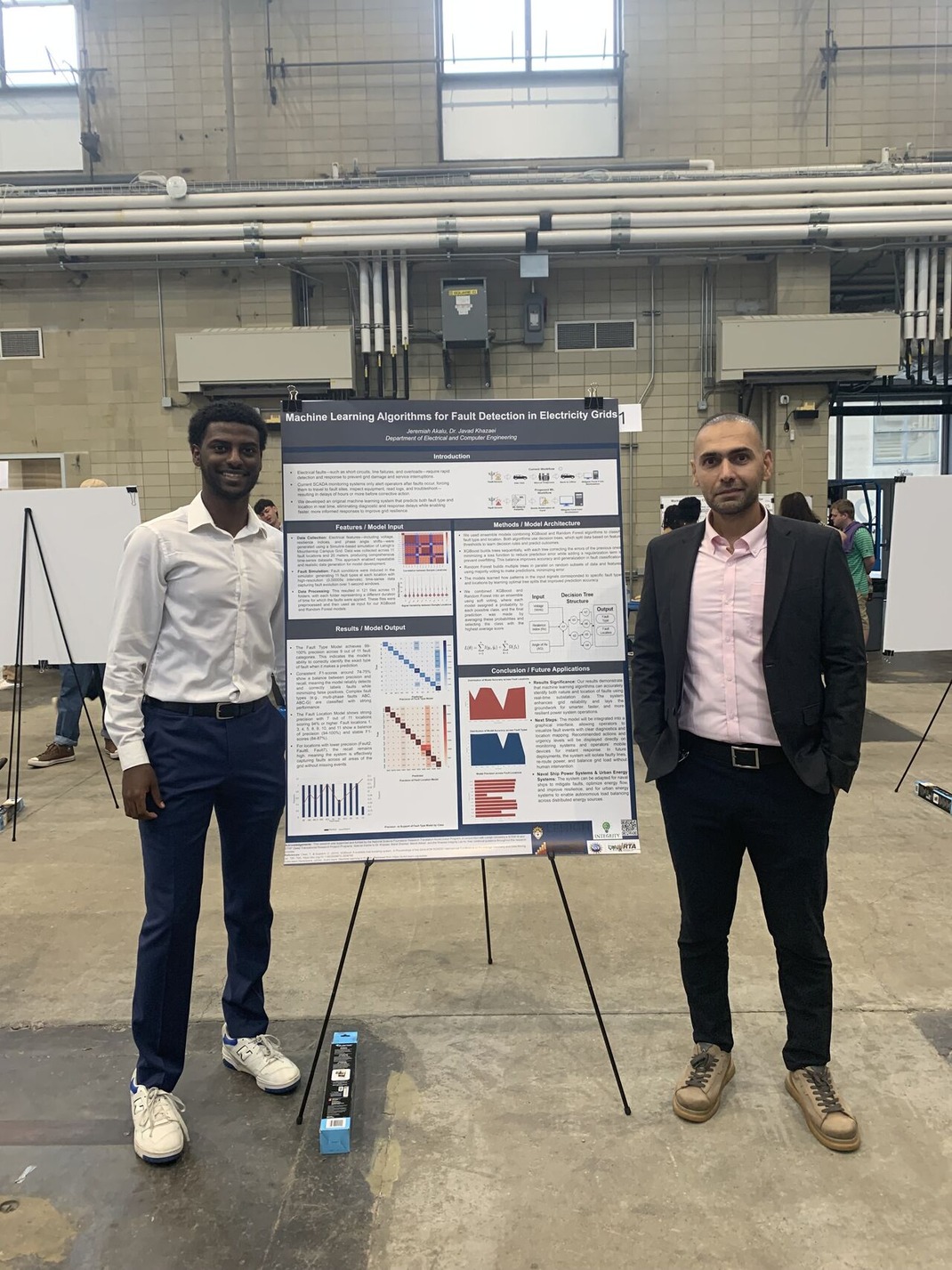
Despite his misgivings, Jeremiah was admitted to the program and landed in Assistant Professor of Electrical and Computer Engineering Javad Khazaei’s
INTEGrated, Resilient, and IntelligenT energY systems (INTEGRITY) lab alongside graduate students Mehdi Akbari, masters’ student focused on grid resiliency, and Maral Shadaei, PhD student in Electrical Engineering.
Khazaei’s lab focuses on resilience in microgrids and interlinked infrastructures, such as water-energy microgrids, as well as data center electrification and artificial intelligence. Over the summer, Jeremiah says, he worked with the lab group on analyzing the Lehigh campus electricity grid. He also worked on a machine-learning algorithm that will be part of a larger platform aimed at making the electrical grid more resilient. The platform will help grid operators understand different faults in the system; as Jeremiah explains, “if there's a blackout, brownout, hurricane, the operator can see if something like this is going to come based on early indicators, which the algorithm will do and essentially prepare for and proactively deal with these.”
He was partnered with Akbari, a graduate student in Khazaei’s lab, to work with the NSF I-Corps Innovation Corps Northeast Innovation Hub, a network of 12 institutions including Lehigh and led by Princeton University. The I-Corps Propelus program focuses on accelerating the economic impact of federally funded research while building researchers’ skills in entrepreneurship. It focuses on, as Coulter describes it, “use-inspired customer discovery.” This involves, basically, focusing on the customer so that the product or service being developed will have a market. Coulter says, “If you develop a new business, how does information, money, and products flow between different components of the ecosystem? Who is your customer? And how are you connecting with them? How does the money flow? They all learned this and more, and they learned by doing.”
Jeremiah was the entrepreneurial lead for his team and Mehdi, as a graduate student, was a technical lead. Jeremiah says that the I-Corps faculty “pushed us to find the viable product to market, to see where the product will fit or if this product is even needed, and where it could be implemented in the marketplace, how it could be commercialized, and how to find customers.”
Jeremiah and the rest of the fellows also attended weekly seminars led by experts, such as Rick Smith, Director of Office of Technology Transfer and member of the RTA team, to round out their view of entrepreneurship and to allow them to ask questions and do a little networking.
He learned quite a bit: from his initial, “intimidated candidate” stage at the outset of the program, he went on to win the “Research Category” award at the end-of-summer Research Day, with recognition of his ability to communicate complex topics clearly.
Seed Translational Research Projects
The second building block of the RTA program is the Seed Translational Research Projects (STRPs). These are research projects that have shown potential real-world applications. The RTA selects projects via a competitive process and provides direct financial support to help the researchers develop prototypes, then helps them translate the project to some form of application.
One of the first STRPs went to a team from the College of Education, led by Lee Kern, Professor and Director of the Center for Promoting Research to Practice, and George DuPaul, Professor of School Psychology, who have developed an assistance model for families with children with ADHD. It is “extremely effective,” Coulter says, adding that “a number of potential outside existing firms are testing this in numerous states across the country at a larger scale than it's been done to date, and several have talked to Lehigh very seriously about potential licensing.”
Major says that the second round of STRPs has recently been chosen, and he notices that the proposals are more polished with each cycle. The proposals now reflect a stronger focus on the translational side of things, instead of seeking primarily to fund a grad student to help with research. That’s a sign, he says, that “we’ve made progress in getting people to think a little more about the translation end of things.”
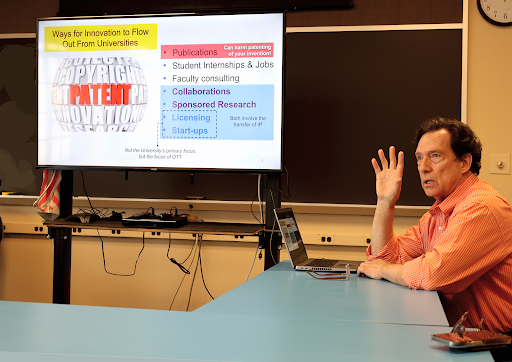
This focus on the translational side gets a large assist from a small, perhaps little-known Lehigh unit, the Office of Technology Transfer (OTT). This two-person shop, consisting of Director Rick Smith and Nora Thomson, Technology Commercialization Associate, guides faculty, postdocs, and students through the steps toward commercialization, from intellectual property protections through patents to licensing issues, founding a company, and more. Coulter says, “the patent process is like a labyrinth. You have to do it in the right order.” He says, “steering the research through various legal protections is our responsibility. We want to provide protection to research and technology rising out of universities.”
Pathway Champions
The pathway champions are a third element of the RTA funnel. These are faculty and staff members who guide the RTA researchers via their own translational experiences. Neal Simon, Professor Biological Sciences, and Michael Rinkunas, Director of the Lehigh Ventures Lab, are Pathway Champions in Venture Creation. Other pathways are Translation to Existing Industry, championed by Himanshu Jain, Diamond Distinguished Chair and Professor in the Department of Materials Science and Engineering, and Kevin Major, Research Engagement Officer; and Societal Impact, led by Won Choi, Professor, Department of Population Health and Associate Dean, Research and Graduate Studies, College of Health, and Lee Kern, Education, Director of the Center for Promoting Research to Practice. Simon has experience with drug development, having founded his own company (Azevan Pharmaceuticals, which focuses on central nervous system disorders) in that endeavor.
As a neuroscientist, Simon knows the drug discovery funding arena. He notes that after 2008, the National Academy of Sciences “literally was writing about the importance of having universities step into the early aspects of drug development—discovery and optimization and animal testing—as a critical national need.” Simon noted that pharmaceutical companies decided that such activities were not financially practical for them. “This is where, he says, “small companies and universities with drug discovery or drug development centers come in. Their intention is often to develop their technologies to the stage where licensing or acquisitions by large companies takes place.”
Universities contribute extensively to the discovery and advancement of drug technologies, says Simon, and that work should be recognized at the university level. As the world of drug discoveries shifts, he says, so should the currency of the academic promotion process, recognizing the changing currency of research and its goals in society. And because so much of the research is supported by public funds, “we have an obligation to disseminate our findings.”
In his field, Simon considers various revenue-producing ways to bridge the Valley of Death via investors. He sees building this research-to-commercialization bridge as an opportunity, although one with a learning curve that involves learning a few new “languages. It is important to understand the “language” of each group to enhance the effectiveness of communications. Simon sees both the academic/nonprofit and business sides of drug development, and says that, “to support the research I want to do, a certain amount of money has to be raised.” Clearly defined goals and objectives are essential, and Simon notes that “these are critical for both grants and investments from private sector sources. Access to additional funding then depends on your ability to meet milestones. For drug development, it’s a multi-year process to demonstrate proof-of-concept, safety, and clinical benefit.”
Institutional Mentorship
In addition to the in-house assets Lehigh has developed, the team also looks outward for guidance and ideas. The NSF-endorsed mentorship with Pittsburgh’s Carnegie Mellon University has proven helpful. The RTA team works with CMU’s Center for Technology Transfer and Enterprise Creation and has benefited from guidance in a number of areas, including potential changes in tenure and promotion requirements. CMU has also shared some of its tools, such as a startup assessment tool (STat) that tests venture viability. The Lehigh RTA team is adapting that tool for use with Lehigh technologies, evaluating projects not only as potential startups but also for licensing and societal impact.
The two teams have also met in person a number of times to share information and for Lehigh researchers to experience the CMU model of research translation. Major says that because of the disparities in size and scope—CMU’s tech transfer office staff is substantially larger than Lehigh’s—Lehigh can’t simply copy the CMU way. But it does give the RTA leadership a look at “how they do things and what we can take from them to see what we can make happen here with our constrained resources,” Major says.
In addition to the CMU relationship, the NSF requires that all ART awardee institutions gather once a year to share progress reports and exchange ideas about their individual programs. Coulter finds this meeting productive, “because we are now part of the nationwide group of people, of institutions trying to do this. And you obviously go faster when you learn from each other.”
Initial Hurdles
The RTA program has established its pathways, recruited students, and mentored researchers making progress on multiple fronts. But like any new program, especially one directed at changing culture, it has encountered some barriers.
One is related to academic culture surrounding credentials and qualifications, particularly for faculty and graduate students engaged in the process of leaving Lehigh in search of jobs to start their careers. While Lehigh might value and reward entrepreneurial activities, hiring committees for academic jobs may still be looking for the traditional credentials of publications and conference papers. Simon indicates this tension when he says, “As a faculty member who supervises people, from undergraduates to graduate students, you have to be sensitive to their professional productivity. And that productivity for at their stage of their professional development is judged primarily by presentations and publications. We're working on that, too.”
Challenges can continue to arise; even with CMU’s mentorship, the RTA program is sailing through some uncharted waters, a journey that will continue as more STRPs come online involving more researchers and more partnerships. But solving problems is something that every growing project faces. Simon says the program needs to be ready to take on a variety of new challenges: “as we take steps to advance RTA in early stages, we identify other processes that need to change or need to be in place. And that's an iterative process.”
Research Culture Change
Coulter is hopeful. “You know, there's a time scale of culture change in universities that isn't always the fastest. But there's definitely a trend toward this not just at Lehigh; it's happening across the nation. And so I definitely see a culture change.” A little short of two years into the project, the RTA can boast significant gains. It has established a range of courses and funded eight STRPs, with several reaching demo/prototype stage or attracting partner interest.
But the most valuable part of the program, to Lehigh and to the university research community in the US, is demonstrating the value of research to society. The RTA shows “boots on the ground” bringing lab-based research to application and making the academic research process visible and impactful. Major notes that, since the 1950s, “Universities are the research engines of the nation. Industry does not do basic research…the people doing basic and applied research are in universities and national labs.” Many things we take for granted have come out of university research: the internet, neonatal CPAP for premature babies, back propagation (an algorithm that helps AI learn from its mistakes), open-source genome sequencing, hepatitis vaccine, e-readers, famine-preventing seeds, rollover bars and seat belts for car safety—the list goes on. Maybe the next big thing—or even the next little thing, vital to someone’s improved life—will emerge from Lehigh research.