
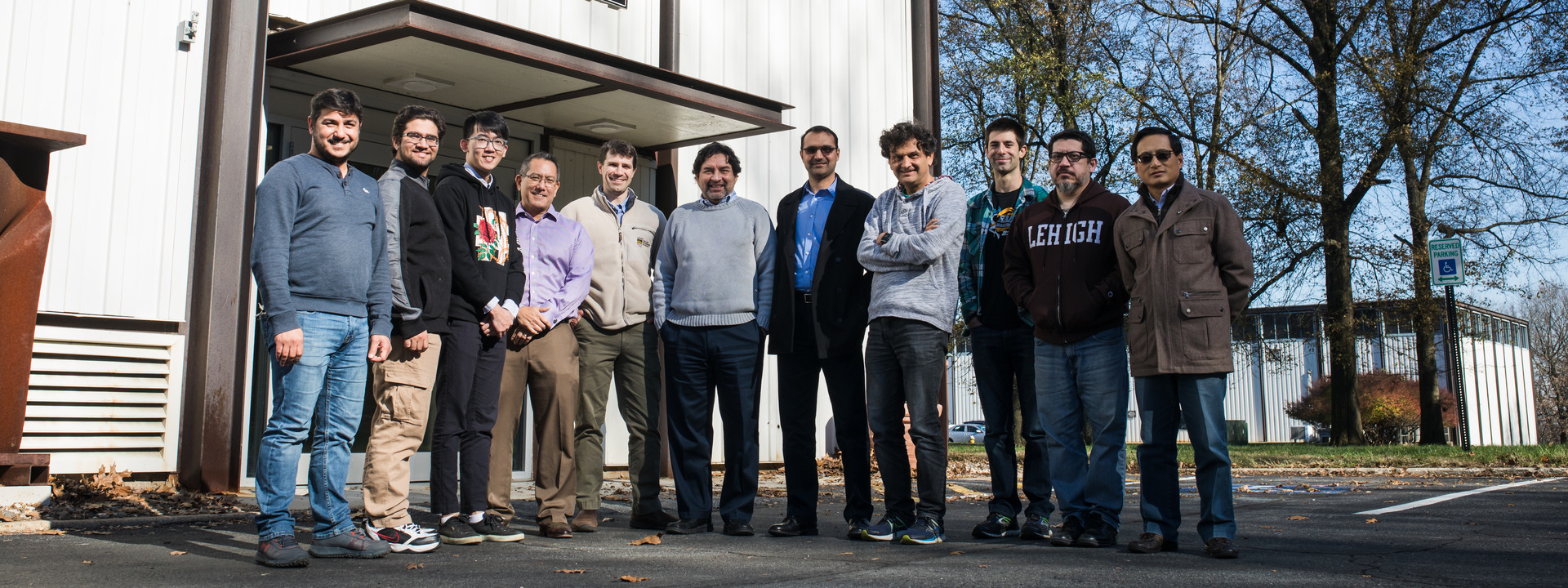
Researchers at Lehigh University’s Energy Research Center (ERC) and the Center for Advanced Technology for Large Structural Systems (ATLSS) received patents on two innovations for energy storage technology in early 2026.
The first patent awarded recognizes a thermal energy storage device and system developed by Carlos Romero, Director of the ERC, Research Full Professor of Mechanical Engineering and Mechanics, and Co-Associate Director of the Institute for Cyber Physical Infrastructure and Energy (I-CPIE); Sudhakar Neti, Professor, Mechanical Engineering and Mechanics; Clay Naito, Professor of Structural Engineering; Alparslan Otzekin, Professor of Mechanical Engineering and Mechanics; Spencer Quiel, Associate Professor of Structural Engineering; Muhannad Suleiman, Professor of Civil and Environmental Engineering; and Zheng Yao, Principal Research Scientist at ERC. The device was designed to act as a thermal battery for thermal-to-thermal and electricity-to-thermal charge-discharge. It can also serve as a cost-effective backup to the electrical grid and as an alternative to the fossil fuel energy sources currently used to patch over the intermittencies of renewable energy.
The second patent awarded went to a team that included Naito, Quiel, Suleiman, Romero, Neti, and Shuoyu Wang, then a graduate student at Lehigh and now a postdoctoral researcher at the University of California, Irvine. Their innovation is a cementitious composition that includes Portland cement and fibers that function to produce a solid media with improved thermal and mechanical properties to sustain cycling operations.
Romero says that the patents are significant for the research centers involved and for Lehigh University. The research was funded by a $2.5 million Department of Energy (DOE) grant and fostered the collaboration between the ERC and ATLSS, both located on the Mountaintop Campus of Lehigh University. “We [ERC] worked on the energy side, the heat transfer, the thermodynamics, and they [ATLSS] were putting the civil engineering expertise in,” says Romero. “That’s why there are two patents, one on the system and one on the concrete formulation.”
The patents are also significant for their novel research, the first large project to perform thermal energy storage research at the university. Romero says, “It got us going in the thermal energy storage space, and after this project we have jointly worked on other research concepts which include latent heat energy storage using phase change materials and pervious concrete, and thermochemical energy storage.” Additionally, since this DOE-supported thermal energy project began in 2019, other energy projects have been undertaken on the Mountaintop campus, including a solar thermal concentrator that efficiently collects solar energy.
The patents are also notable as they cover the second innovation developed at Lehigh that has employed the university’s recently created Express Startup License program for faculty and students desiring to start a new venture around their research intellectual property. (The first is CarboVolt Labs, headed by Kai Landskron, Professor of Chemistry.) The licensing aspect of the program is managed out of the Office of Technology Transfer (OTT), headed by Rick Smith, the OTT Director. The Express License allows Lehigh researchers to accelerate their entrepreneurial efforts, streamlining the process of licensing intellectual property. Smith has noted that the OTT has standardized the licensing process so that it’s faster and a bit easier than the typical process. Romero says, “Any faculty who wants to license any technology that they develop, they can license it quickly in months, and they can have a startup.” Traditionally, the patent application and prosecution process can require a series of steps including forms, approvals, back and forth with the U.S. Patent Office, and hefty fees, plus a series of revisions, and take several years until a patent is finally issued. For Romero, Neti, and Naito, the patent process led to the formation of a company, Energy Storage Technologies, Inc. (EST), which can develop and commercialize the technology to the external marketplace around the world.
The motivation behind this research derives from the potential and shortcomings with renewable energy. Renewable sources, such as solar and wind, are becoming low-cost options and widely available–positives in the energy world. But their intermittence, caused by sunsets and clouds, among other factors, can present issues for the smooth, reliable operation of the electrical grid, which works best with a more continuous supply of energy. This electricity “duck curve” of reduced midday demand and evening ramp-up can cause temporary demand-supply mismatches, resulting in reliability issues for the electrical grid. Electricity price disruptions can also occur during periods of oversupply, or times when more energy is produced than demand requires. Intermittencies or outages of either type can bring back reliance on fossil units, like coal- and natural gas-fired power plants. This situation can result in operational and maintenance issues for conventional power plants, introduced by cycling, operation at extreme low-loads, and rapid ramping and startups.
This is where thermal energy systems can help. The Lehigh thermal energy system covered by these two patents can step in to support the reliable supply of electricity by effectively collecting, storing, and releasing energy as needed.
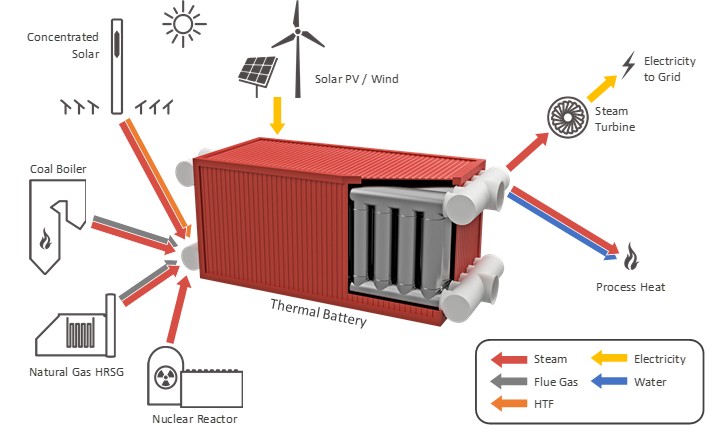
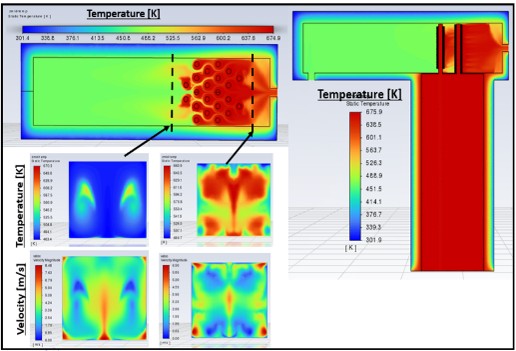
The Lehigh thermal battery is a very clever concept, consisting of multiple components that work as a system. The main component is a block of concrete that has been engineered with innovative components by the civil engineering researchers to be able to sustain repeated thermal and mechanical cycles. The concrete is cast with thermosyphons, which are tubes filled with a liquid selected for the specific temperature range of operation. During charging, the bottom of finned thermosiphons are exposed to hot gas, air, steam, or even electricity. The heat moves up the thermosyphon quickly and charges the concrete in an isothermal fashion. For example, you might be capturing thermal energy from a solar field. During the day while the sun is shining, you expose the bottom of the thermosiphon to this energy from the solar collector, and it charges the battery. At night, the sun is gone and the concrete becomes the discharging component. You can discharge heat energy from the concrete as steam or hot air to continue your operations during the night at the top of the thermosyphon, sliding the operation of these devices.
As the United States and other nations see an increase in energy use, there will be a need to produce more energy from a diverse set of sources, whether they are renewables like solar and wind or more conventional fuels such as natural gas and coal. Because of this, the technology developed by the ERC-ATLSS collaboration could play a vital role in keeping the electricity grid functioning reliably.